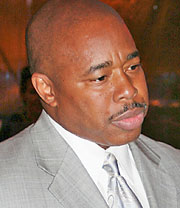
State Sen. Eric Adams might be forced to pack up his apartment and move thanks to new district lines drawn up by his political rivals in Albany.
Senate Republicans proposed new maps for legislative districts on Thursday afternoon that would cut the Prospect Heights Democrat out of his district and put his apartment inside territory controlled by Velmanette Montgomery (D–Fort Greene).
Adams has already vowed not to challenge Montgomery for the seat, claiming instead he will move a few blocks south into a new ostrich-shaped district that includes Crown Heights, Prospect Heights, Fourth and Fifth avenues, and Sunset Park.
“It’s clear that there was an intention to disrupt the process for running for office,” said Adams. “I’m not going to participate in this confusion. I’m sure people who move into my old apartment will enjoy their new senator.”
The suggested alterations would send state Sen. Kevin Parker (D–Flatbush) into Greenwood Heights, Prospect Park and Park Slope, while Montgomery’s district, which includes Red Hook, Carroll Gardens, Boerum Hill, Fort Greene, and Bedford Stuyvesant, would become more compact due to new population data.
“Some of this stuff is just like, huh?” said Montgomery spokesman Jim Vogel. “It’s like the Marx brothers did redistricting and settled a few scores.”
State legislators redraw district lines for State Assembly, State Senate, and US Congress, once every 10 years after new US Census figures come out. This year, Republicans, who hold a one-seat majority in the State Senate, will draw Senate maps, while the Democratic majority in Assembly will propose Assembly maps.
But some politicians, including State Assemblyman Hakeem Jeffries (D-Fort Greene) — who saw his own apartment drawn out of the 57th Assembly district 10 years ago — said that public officials aren’t the ones who should be drawing the lines.
“The Senate GOP has once again abused the redistricting process to protect incumbents, punish the opposition and artificially maintain their power,” said Jeffries, who has launched a Congressional run that would take him out of an Assembly district slated to lose Park Slope but gain the Ingersoll and Whitman houses. “The poisonous use of the gerrymander by the Senate majority undermines the integrity of our democracy.”
The state will hold a public hearing on the new maps at St. Francis College on Feb. 1, but Gov. Cuomo — who has the final say on redistricting — has already sworn to veto this iteration.
If Cuomo nixes the Republican Senate redistricting proposal, Albany politicians could negotiate a solution — or the fight could move to the courts.
When the maps are made official, legislators who have been drawn out of their districts can choose to move to a new district by January 2013 or face off against whoever gained their territory.
Adams says he will find a new home if the redistricting becomes the law of the land — but he might send Republicans a bill for the moving costs.
“That would be a good thought,” he said.
Adams isn’t the only Brooklyn lawmaker whose district might change significantly.
State senators Marty Golden (R-Bay Ridge) and John Sampson (D-Canarsie) gobbled up the remnants of disgraced former State Sen. Carl Kruger’s Marine Park base, in the proposed maps.
Reach reporter Aaron Short at ashort@cnglocal.com or by calling (718) 260-2547.