
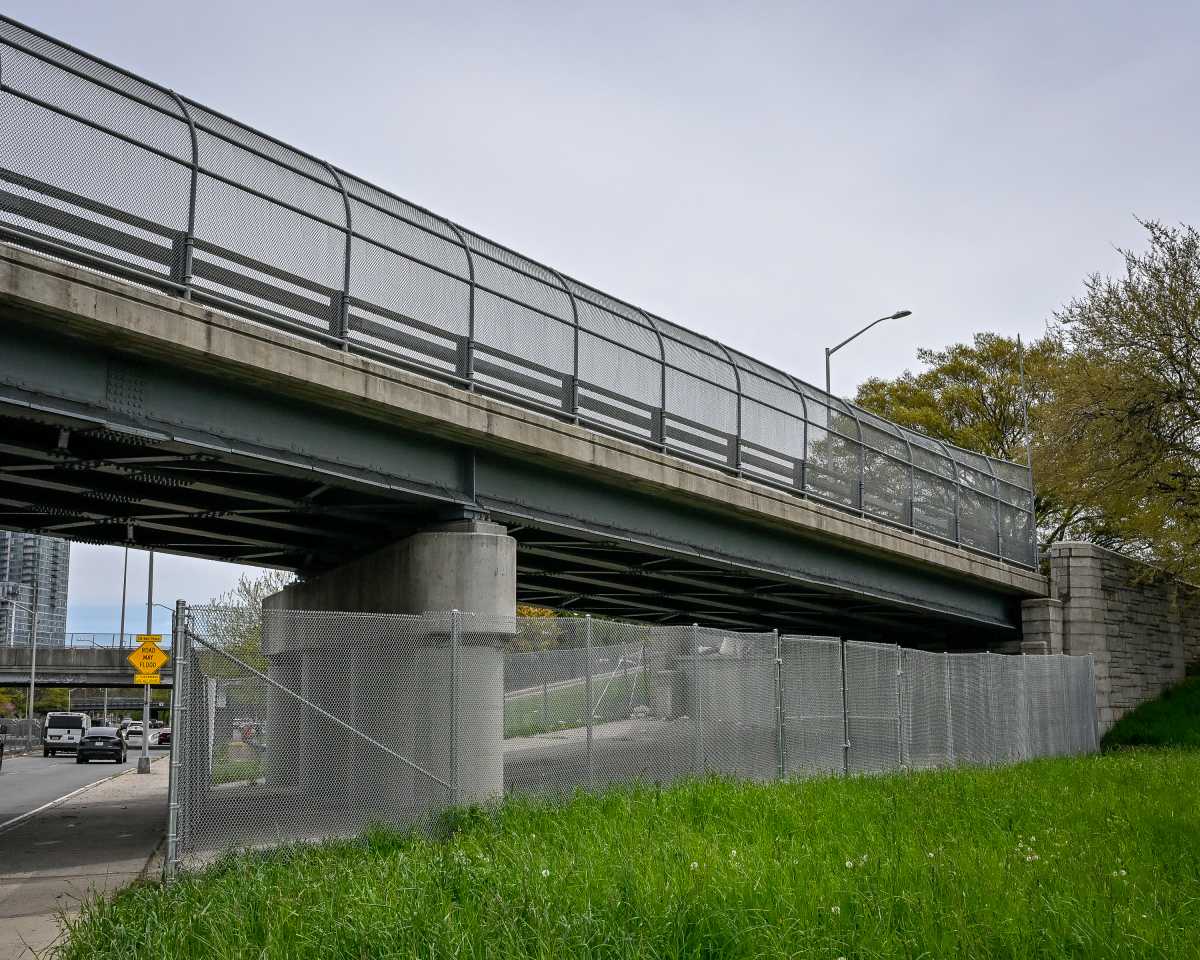
A long-standing homeless encampment under a Belt Parkway overpass in Sheepshead Bay was cleared by city agencies last month and fenced off after years of complaints about safety and sanitation. During a recent visit, Council Member Inna Vernikov said the site reflects a larger struggle over how New York handles homelessness, mental illness and street outreach.
It’s been a little over a month since multiple city agencies — including the NYPD, Department of Homeless Services (DHS), Department of Sanitation (DSNY), and Department of Transportation (DOT) — in coordination with Vernikov, who represents the 48th District in South Brooklyn, cleared a homeless encampment beneath the overpass near Exit 8 of the Belt Parkway and Guider Avenue in Sheepshead Bay. Officials also installed a fence to prevent further access to the area by unhoused individuals and to discourage the re-establishment of encampments.
The move came after neighbors had complained for years about tents, drug use, and sanitation issues at the site. Vernikov, whose district includes Sheepshead Bay, told Brooklyn Paper during a tour of the site on April 28 that the encampment had been a major source of complaints from her constituents, noting that homeless encampments were a quality-of-life issue not only for residents but also for unhoused individuals.
“We don’t want homeless people to live like this, right? So, it’s an issue for everyone. It’s an issue for the residents. They want to be in a safe, clean neighborhood. They pay taxes, they live here. The kids go to school here. But it’s also an issue for homeless individuals,” Vernikov said. “We want them to live in a dignified way. This is not a way for them to live.”
Vernikov stressed that addressing homelessness required policy change from the Mamdani administration, given that many unhoused individuals struggle with mental health issues and drug addiction.
After Mayor Zohran Mamdani paused homeless encampment sweeps shortly after he was sworn into office in January, he reinstated them in February with modified policies, appointing DHS as the lead agency overseeing the sweeps instead of the NYPD. The updated approach included daily outreach for one week before clearing encampments in an effort to build trust with people living in them before providing services. His predecessor, Mayor Eric Adams, issued a notice on the first day and cleared encampments on the seventh day without additional outreach.
Vernikov emphasized the need for policy changes that would provide more effective mental health treatment for unhoused individuals with mental health concerns, including involuntary commitment of individuals who are a danger to themselves or others. She noted limitations in current city policies, which often prevent immediate action unless a crime is being committed, and called for clearer guidelines and faster agency response times.
“It’s inhumane to leave them on the street. I don’t understand the constant push from some advocates to keep these people on the street and allow them to live like this. You saw during the winter because of Mayor Mamdani’s policy to leave them [and] a lot of them froze to death,” she told Brooklyn Paper. “If there isn’t a policy change, we’re gonna see a lot of these people suffering, and this is also really detrimental to the quality of life of the residents who live around these areas.”
Vernikov’s office works closely with DHS and Breaking Ground, a nonprofit that provides supportive and affordable housing and operates 24/7 street outreach programs for unhoused individuals. While Northern Brooklyn has a large concentration of homeless shelters, accommodations in Southern Brooklyn are more limited.
According to NYC Open Data, there are nine shelters — including adult and family facilities — in Community Board districts 13, 14 and 15, which overlap with Vernikov’s district. Residents in Bensonhurst, which falls in Council Member Susan Zhuang’s district, have also pushed back against a planned 150-bed men’s shelter at 86th Street and 25th Avenue.
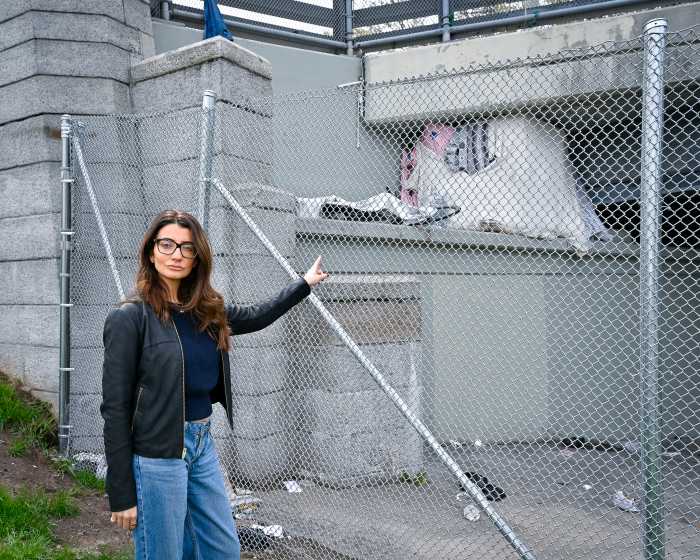
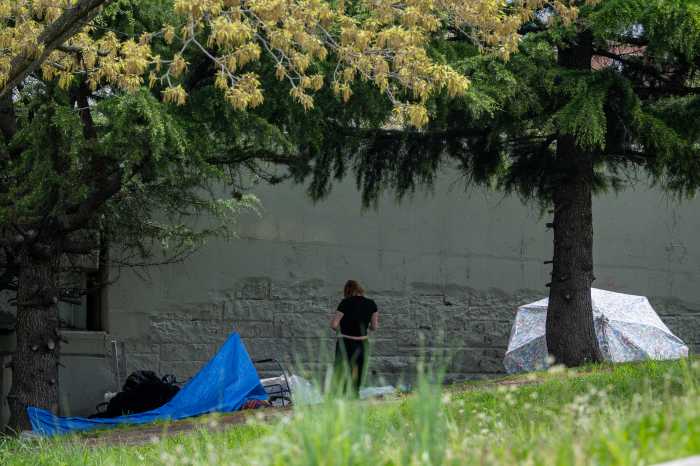
During the tour, Brooklyn Paper and Vernikov observed an encampment on a wall ledge beneath the overpass in a gated area, as well as a smaller setup along the wall of Coney Island Avenue that included a beach umbrella, a shopping cart, a blue tarp tent, and chairs. An apparently female unhoused person was seen tidying the area, while another individual lingered near the overpass.
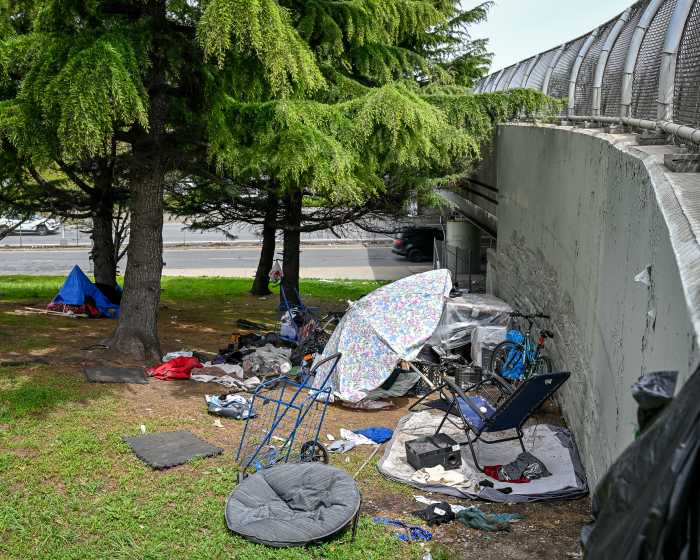
Vernikov called her chief of staff, who immediately contacted DHS and Breaking Ground. Breaking Ground visited the site a few hours later but encountered only one individual lying down who declined to give his name. He said he was passing through but resting and would be leaving soon. The team offered drop-in center resources and services, which he declined.
“We can still have a reasonable policy that is humane towards the homeless, and at the same time, keeps our streets safe and clean. There really has to be a change on the mayor’s side, because this is a policy that’s made by the mayor,” Vernikov said.
Mamdani’s office did not immediately respond to requests for comment regarding the encampment and the council member’s efforts.