





Organic plants, not concrete plants!
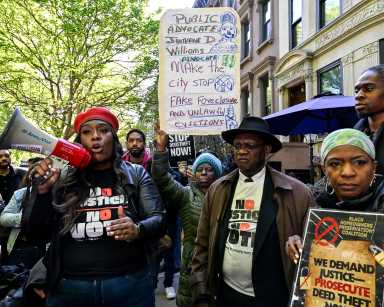
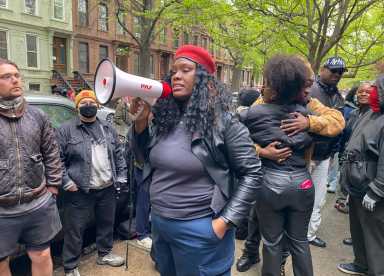
That was the message that Red Hook residents delivered last Saturday, when about 40 neighbors donned face masks to protest the planned opening of a concrete plant next to the Beard Street Ikea — across from a community farm and near popular playing fields.
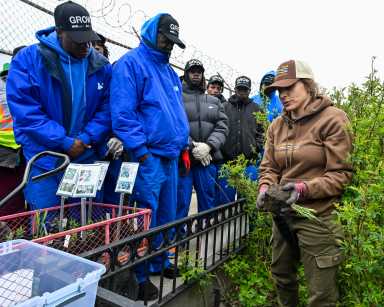
The neighbors, who carried signs reading “No More Pollution” and “Honk 4 No Cement,” said they oppose the plant because its fine dust would coat the organic pumpkins and eggplants at the Red Hook Community Farm.
“What ticks me off is that it’s next to an organic farm. I don’t think those vegetables would be organic any more,” said J.E. McKnight, co-chairman of the Red Hook Civic Association.
US Concrete, the Texas-based conglomerate that is putting the finishing touches on the plant, has said that 15-20 trucks would be based there, and one protestor said that could drive baseball players out of Red Hook Park one block away.
“We worked very hard to get a field for the Little League, but I don’t think we’d bring the kids here to breathe fumes,” said Pete Morales, commissioner of the neighborhood’s Little League.
The activists face an uphill battle. The site is zoned for heavy industry — a legal designation that permits even more noxious uses like glue factories, slag heaps and garbage incinerators — and the plant appears to be nearly ready to open.
Councilwoman Sara Gonzalez skipped the protest, but an aide to state Sen. Velmanette Montgomery (D–Red Hook) said his office would keep fighting the plant because the neighborhood has changed since the “heavy industry” zoning was put in place decades ago.
“I don’t think they appreciate the density of this area and how litigious New Yorkers can be,” said the aide, Jim Vogel. “If you’re opening a cement plant in an area with a 40-percent asthma rate, you’d better open your pocket book, because you’re going to be spending a lot of time in court.”
Kids who volunteer at the community farm agreed.
“Putting a cement plant right next to a park — how stupid can they be? They should put it in the desert so it doesn’t affect anyone,” said Matilda Armstrong, 11.
Concrete plants are often located in densely populated areas because the widely used material needs to get from the plant to construction sites within the five boroughs quickly or it hardens and becomes useless.has
©2009 Community Newspaper Group
By submitting this comment, you agree to the following terms:
You agree that you, and not BrooklynPaper.com or its affiliates, are fully responsible for the content that you post. You agree not to post any abusive, obscene, vulgar, slanderous, hateful, threatening or sexually-oriented material or any material that may violate applicable law; doing so may lead to the removal of your post and to your being permanently banned from posting to the site. You grant to BrooklynPaper.com the royalty-free, irrevocable, perpetual and fully sublicensable license to use, reproduce, modify, adapt, publish, translate, create derivative works from, distribute, perform and display such content in whole or in part world-wide and to incorporate it in other works in any form, media or technology now known or later developed.