Excellence Boys Charter School is among the first New York City charter schools to take the lead in teaching students about a long-neglected topic: financial literacy.
Last month, the New York State Board of Regents adopted an amendment to Section 100.2 of the Regulations of the Commissioner of Education, approving a statewide mandate that will provide personal finance education to all public school students in grades K through 12.
Under the new requirement, students will be introduced to core financial concepts — including budgeting, saving, credit and investing — as part of a phased rollout across grade levels.
Middle school (grades 5–8) and high school students (grades 9–12) will be able to receive financial instruction as early as the 2026–2027 school year, while elementary students will begin in the 2027–2028 school year. Excellence Boys, a PreK-8 school in Bedford-Stuyvesant, is leading the way as the first Uncommon charter middle school to offer this type of curriculum.
Excellence Boys Principal Jermaine Issac introduced the financial literacy program earlier this year after taking over the role following his departure from Uncommon Bed-Stuy East Middle School. Issac previously worked at Excellence Boys in 2016 and returned last year. One of his goals was to enhance the student enrichment curriculum. After nearly 10 years in education in Brooklyn, and reflecting on his own upbringing in Baltimore, he said he believes financial literacy education is a necessity for his Black and Brown students.
“When I think about when I was a child, what I needed, and now what I think about as an adult, I wish I had financial literacy at a younger age,” Issac said. “Financial literacy is extremely important because we live in America, and you have to know how to get a house, how to balance a checkbook, how to manage credit, how to even manage debt when you come out of college.”
According to data from the latest Poverty Tracker report from the Robin Hood Foundation and Columbia University, Black residents living in Bedford-Stuyvesant were nearly twice as likely to live in poverty as their white counterparts (27%). Black residents also, on average, experience greater material hardship, with 32% facing reductions in basic necessities — such as food, housing, utilities and health care — due to a lack of financial resources.
In a community lacking adequate educational resources and opportunities, a financial literacy course could help change the trajectory of generational wealth gaps for students and their families, Issac said.
“Parents are extremely invested and come into our school now to learn more about the program and how we can expand it,” he said. “They want to actually join in on the conversation on what it means to be financially literate because their kids are now going home speaking to them about how to be debt-free, how to manage credit, and how to invest in companies and stocks.”
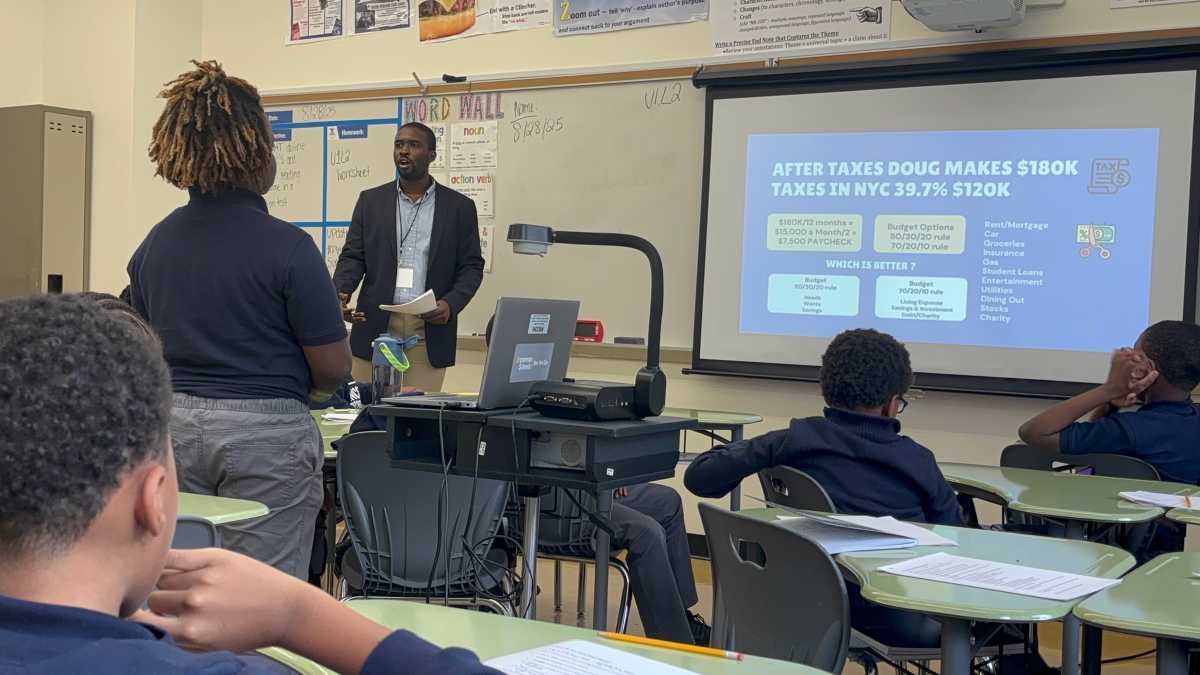
While at Bed-Stuy East, Issac worked with Patrick Oseni, who at the time was the school’s physical education teacher. After learning more about Oseni’s business experience — he graduated from Howard University with a business degree — Issac brought him on as a financial literacy teacher. Oseni was responsible for creating the school’s first financial literacy curriculum.
Oseni, a first-generation American and college student, grew up modestly with his Grenadian mother and Nigerian father. He took out multiple loans while matriculating through college and said he remains burdened by debt a decade later.
“Pouring into these boys, the idea is that when they graduate from college, they will have an idea of how to budget their money, invest their money, know the difference between a need and a want, and learn about sacrificing for the future,” he said.
Oseni said he hopes the curriculum he built for Excellence Boys will reach other schools and students. “If I can show them that hey, I was a student like you in Brooklyn, I graduated from college from one of the best universities, if they can see a role model in their community, they will be able to do and achieve things as well.”
The financial literacy program has encouraged students to create their own businesses and explore different occupations. Students compete in pitch competitions showcasing their ventures. One sixth grader, Adrian, pitched his bracelet business to the class, aiming to redefine men’s fashion.
Adrian said the program has helped set him up for success.
“This class impacted me as a student because it gave me the chance to learn that I could be an entrepreneur when I grow up and it helped me set goals for my future and helped me realize who I could be.”